When a finished food product tastes artificial, harsh or unbalanced, the first reaction is often to blame the flavor or reduce the dosage. That response may work in some cases, but it can also hide the real cause.
The same sensory problem may come from an unsuitable flavor profile, an unstable product base, inaccurate dosing, poor dispersion, the wrong addition stage, severe processing conditions, or interactions with sweetness, acidity, fat, protein and other ingredients.
Effective troubleshooting therefore requires a controlled sequence. The goal is not simply to make the flavor weaker. It is to identify why the flavor does not integrate with the finished product and confirm a correction that remains stable in real production.
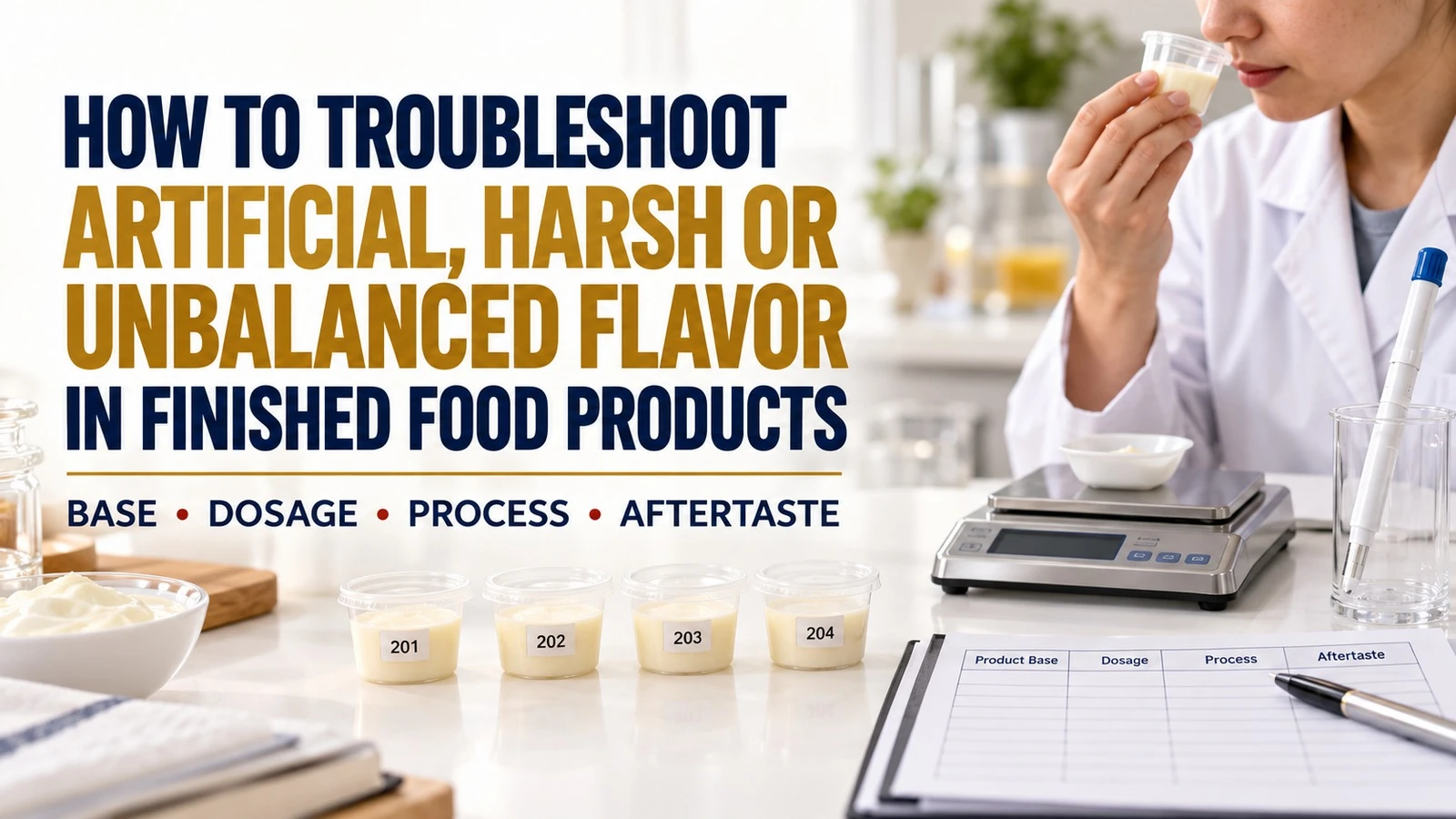
1. Define What Artificial, Harsh or Unbalanced Means
Before changing the formula, describe the defect precisely. Words such as artificial, chemical, perfumy, sharp, flat, bitter, heavy and lingering may refer to different sensory problems. If each evaluator uses the same word for a different sensation, the team may adjust the wrong variable.
Record where the problem appears: in the aroma before tasting, at first impact, in the middle of the taste, or in the aftertaste. Also record the serving temperature, sample age, batch number and processing history. A flavor that seems sharp when warm may become balanced after cooling, while an acceptable fresh sample may develop an unpleasant finish during storage.
Use a simple reference scale and ask evaluators to score intensity, naturalness, product fit and aftertaste separately. This converts a vague complaint into observations that can be compared across trials.
2. Check the Product Base Before Adjusting the Flavor
A flavor can only be evaluated correctly in a stable product base. Oxidized fat, stale protein, poor-quality cocoa, excessive spice, mineral notes in water, or inconsistent raw materials can create an artificial impression even when the flavor dosage has not changed.
Prepare an unflavored control from the same batch. Taste it under the same conditions as the flavored samples. If the control already has bitterness, metallic notes, oxidation, excessive acidity or an unpleasant finish, correct the base first instead of asking the flavor to hide the defect.
Flavor should never be used to mask spoilage, contamination or an unsafe raw material. Confirm raw-material quality and food-safety compliance before sensory optimization begins.
3. Confirm Whether the Flavor Profile Matches the Product
A technically acceptable flavor may still be the wrong profile for the application. A bright, fresh strawberry profile may feel disconnected in a cooked bakery filling. A creamy vanilla may make a clear beverage feel heavy, while a roasted meat profile may be too dark for a lightly seasoned chicken product.
Define the target more specifically than a flavor name. Decide whether the finished product should be fresh, ripe, cooked, creamy, juicy, roasted, green, spicy or clean. Compare the sample with a market reference or an agreed internal standard, and evaluate profile direction separately from total strength.
If the direction is wrong at low, medium and high dosage, changing the dosage will not solve the mismatch. A different flavor profile, a blend, or a supporting note may be required.
4. Compare Controlled Dosage Levels
Do not respond to a harsh result by making a large, unmeasured reduction. Prepare a controlled series using the supplier's recommended range as a starting point. Include an unflavored control and at least three flavored samples at low, medium and high levels.
Keep the product base, batch size, mixing order, process and storage time constant. Weigh the flavor accurately rather than estimating by drops or spoon volume. Use smaller increments around the best-performing level once the first comparison identifies the useful range.
Over-dosage can create perfumy top notes, bitterness, throat impact or a long artificial finish. Under-dosage can also seem unnatural because the flavor appears as a thin top note while the base remains exposed. The target is integration, not simply the lowest or strongest sample.
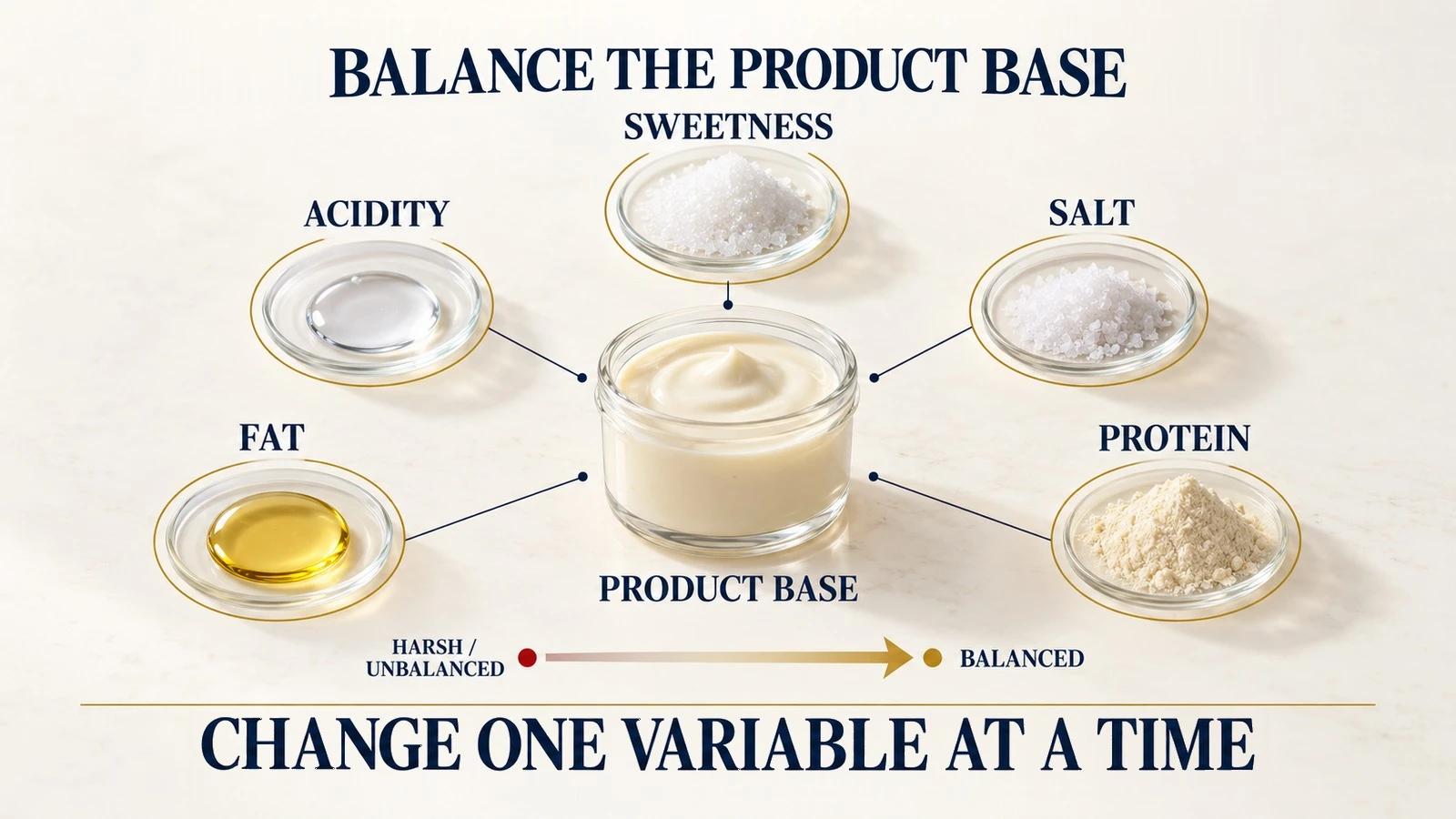
5. Check Sweetness, Acidity, Salt, Fat and Protein Balance
Flavor perception depends on the surrounding formula. Sweetness can support fruit, dairy and vanilla notes, but excessive sweetness may make them heavy or candy-like. Acidity can add freshness and definition, yet too much acid may make citrus or fruit flavors feel sharp and may increase throat impact.
Salt and umami can strengthen savory character, while excessive salt may emphasize harsh edges. Fat can round some notes and delay aroma release. Protein, starch, gum, cocoa and spices can bind, mask or redirect flavor perception. High-intensity sweeteners may also introduce a delayed sweetness or bitter aftertaste that is incorrectly blamed on the flavor.
Change one supporting variable at a time. Small controlled adjustments to sweetness, acid, salt or fat balance often produce more useful information than repeatedly changing the flavor dosage.
6. Confirm Dispersion and Mixing Uniformity
An unevenly dispersed flavor creates local hot spots. One spoonful may taste balanced while another seems chemical or weak. This is especially common when a concentrated liquid is added directly to a viscous base, when a powder forms agglomerates, or when the batch is too small for the mixing equipment.
Use a compatible premix or carrier when appropriate, and follow the supplier's handling guidance. Check the order of addition, mixing speed and mixing time. Avoid unnecessary aeration or excessive mixing that may increase volatile loss.
Take samples from different positions in the vessel and compare them blind. If the samples vary, correct the mixing procedure before making a sensory decision about the flavor itself.
7. Review the Addition Stage and Processing Conditions
The same flavor can perform differently depending on when it is added. Early addition may improve distribution but expose volatile notes to heat for longer. Late addition may protect top notes, yet insufficient mixing can leave the batch uneven. The suitable stage depends on the product, process and flavor format.
Reproduce the actual heat treatment, shear, pressure, holding time, evaporation and cooling conditions. Heating may remove fresh top notes, reveal heavier base notes, or generate new cooked notes from the food matrix. Freezing, baking, frying, retorting and fermentation can each shift the balance in a different way.
If the fresh laboratory sample is balanced but the processed sample is harsh, compare addition stages and process exposure before changing the flavor profile.
8. Evaluate After Heating, Cooling and Storage
A result should not be approved from a single tasting immediately after mixing. Evaluate the sample at the stage in which the customer will actually consume it. For a beverage, this may mean chilled and after 24 hours. For bakery or confectionery, it may mean fully cooled and again after packaging.
Include more than one time point: immediately after processing, after equilibration, and at relevant storage intervals. Observe whether the initial sharpness fades, whether desirable top notes disappear, or whether bitterness and aftertaste become stronger.
Use the intended package where possible. Oxygen exposure, light, headspace, moisture transfer and interaction with packaging can change the sensory result. A correction is only reliable if it remains acceptable through the product's realistic use and storage conditions.
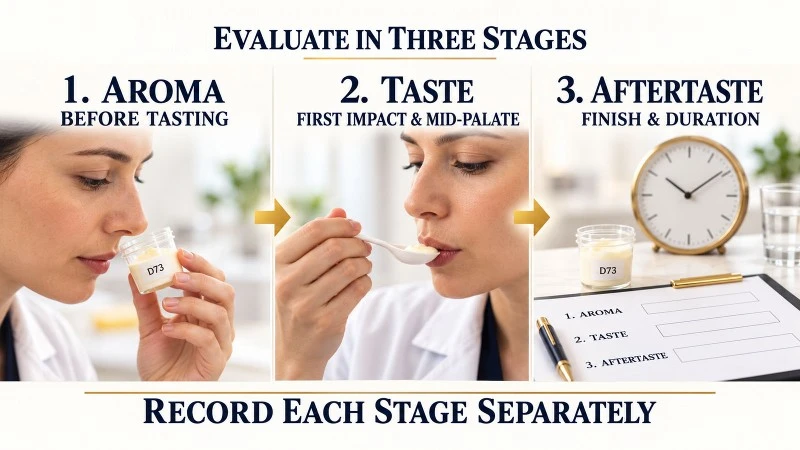
9. Separate Aroma, Taste and Aftertaste During Evaluation
A sample can smell attractive but taste unbalanced. It can also taste acceptable at first and leave a harsh or artificial finish several seconds later. Evaluate these stages separately instead of giving one overall score.
First assess the aroma without tasting. Then record first impact, mid-palate character and finish. Note the duration of sweetness, acidity, bitterness, cooling, warming and flavor identity. Allow enough time between samples, use neutral palate cleansers, and avoid comparing too many samples in one session.
Use coded samples and collect individual scores before group discussion. This reduces the risk that one person's description influences the entire panel.
10. Recognize Common Signs of Over-Dosage
Typical signs include a perfumy or solvent-like aroma, excessive sharpness, bitterness, throat irritation, a heavy lingering finish, loss of the expected food identity, and a flavor that sits above the product instead of blending into it. In savory products, over-dosage may make the profile too dark, smoky or seasoning-like. In fruit and dairy products, it may create a candy-like or cosmetic impression.
However, these signs do not prove that dosage is the only cause. A mismatched profile, poor dispersion, excessive acid, high-intensity sweetener aftertaste, oxidation or severe process exposure can produce similar symptoms.
Reduce dosage only as a controlled test. Compare that result with a corrected base, a revised addition stage or an alternative profile so the team can identify the true cause.
11. Confirm the Correction at Pilot or Production Scale
A bench-top correction must be confirmed at a larger scale. Production equipment changes mixing efficiency, heat-up and cool-down time, shear, evaporation, hold time and the sequence of ingredient addition. These differences can change both flavor intensity and balance.
Run a pilot or carefully controlled production trial using the selected dosage and process. Sample from more than one point in the batch, record actual processing conditions, and retain samples for follow-up evaluation. Compare them with the approved laboratory reference under the same serving conditions.
Do not compensate for scale-up uncertainty by adding extra flavor without evidence. Finalize the specification only after the result is repeatable across batches and remains acceptable at the required storage points.
12. Final Troubleshooting Checklist
Before approving a correction, confirm each of the following:
✓ The sensory problem has been described precisely, including when it appears.
✓ The unflavored base and raw materials are acceptable and consistent.
✓ The flavor direction matches the target product and reference.
✓ Low, medium and high dosage levels were compared with accurate weighing.
✓ Sweetness, acidity, salt, fat, protein and other major interactions were reviewed.
✓ Dispersion, mixing order and sample uniformity were confirmed.
✓ The real addition stage and processing conditions were reproduced.
✓ Aroma, taste and aftertaste were evaluated separately.
✓ Samples were checked after processing, cooling and relevant storage periods.
✓ The selected correction was confirmed at pilot or production scale.
13. Conclusion
An artificial, harsh or unbalanced flavor is a symptom, not a complete diagnosis. The cause may be excessive or insufficient dosage, a mismatched profile, an unstable product base, poor dispersion, the wrong addition stage, processing damage or a change that appears only after storage.
A reliable solution comes from controlled comparisons. Define the defect, check the base, confirm the profile direction, compare dosage levels, review formula interactions, reproduce the real process and evaluate over time. This approach reduces guesswork and helps the development team choose a correction that can be repeated in commercial production.
HiDoo provides liquid and powder food flavors, sample support and application guidance for beverage, bakery, confectionery, dairy, savory and seasoning products.
www.hidoofood.com
gary@hidoofood.com