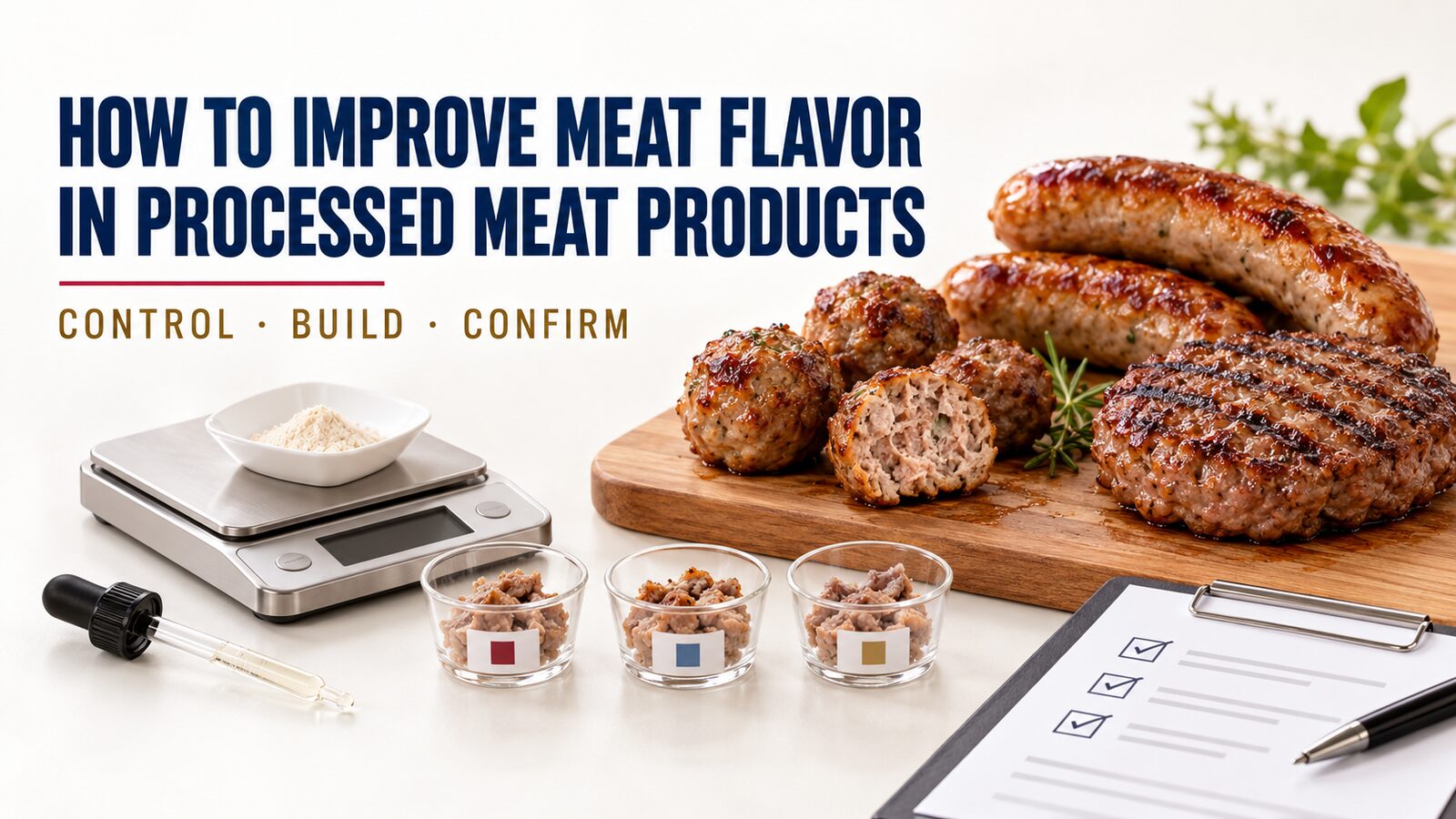
A processed meat product can contain adequate salt, spices and seasoning and still lack a clean, convincing meat character. The aroma may seem weak after cooking, frozen raw-material notes may remain noticeable, or the finished product may taste savory without clearly tasting like cooked meat.
These problems do not always come from insufficient flavor dosage. Raw-material quality, fat-to-lean ratio, moisture, protein binding, spice balance, cooking loss, heating conditions and the way the flavor is incorporated can all change the final result.
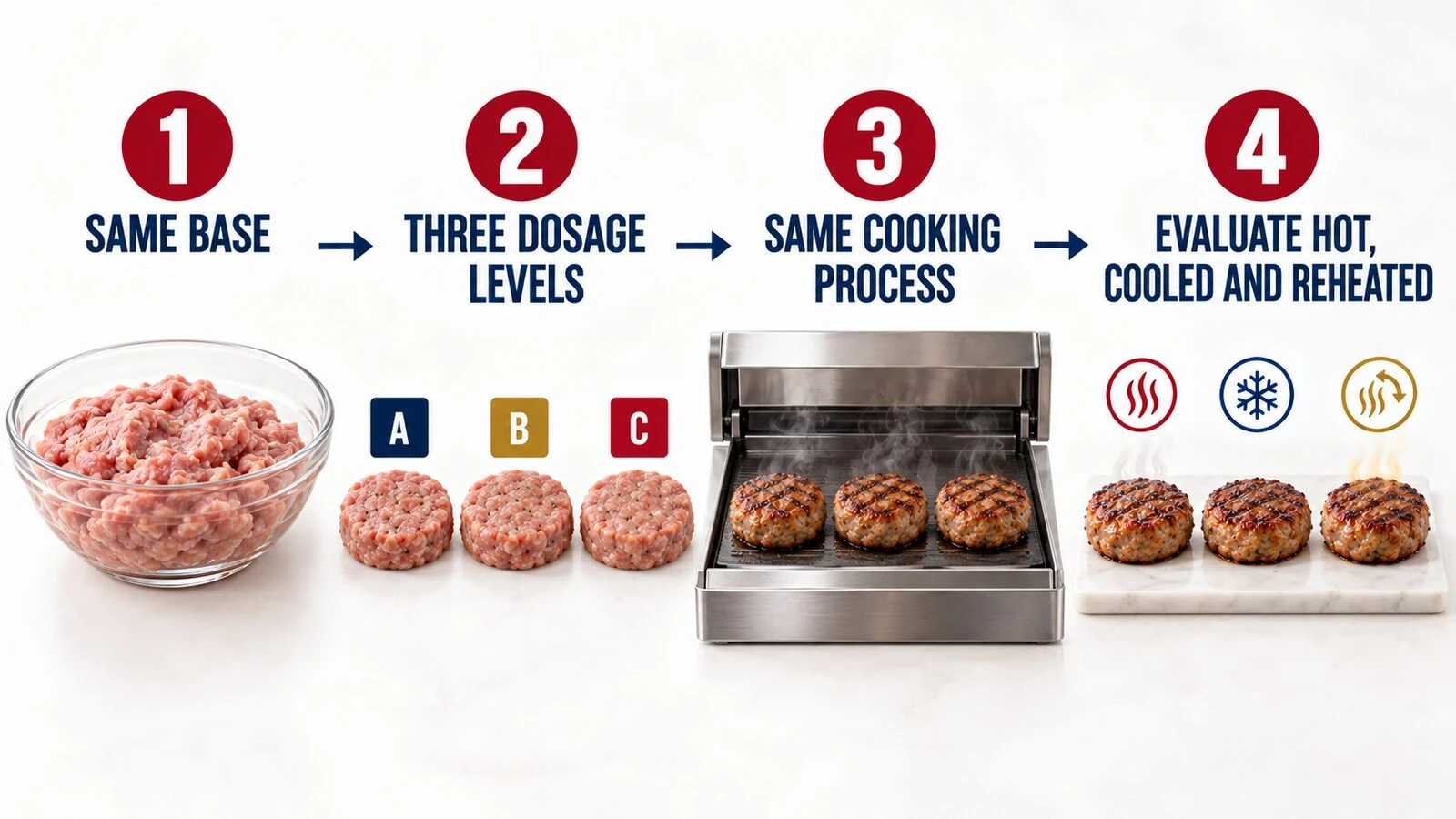
A reliable improvement therefore starts with diagnosis. The development team should identify the specific weakness, compare controlled dosage levels in the actual formulation, process every sample under the same conditions and evaluate the product after cooking. Adding more flavor without that control can increase bitterness or create an artificial top note while leaving the original problem unresolved.
1. Start with Qualified Raw Materials
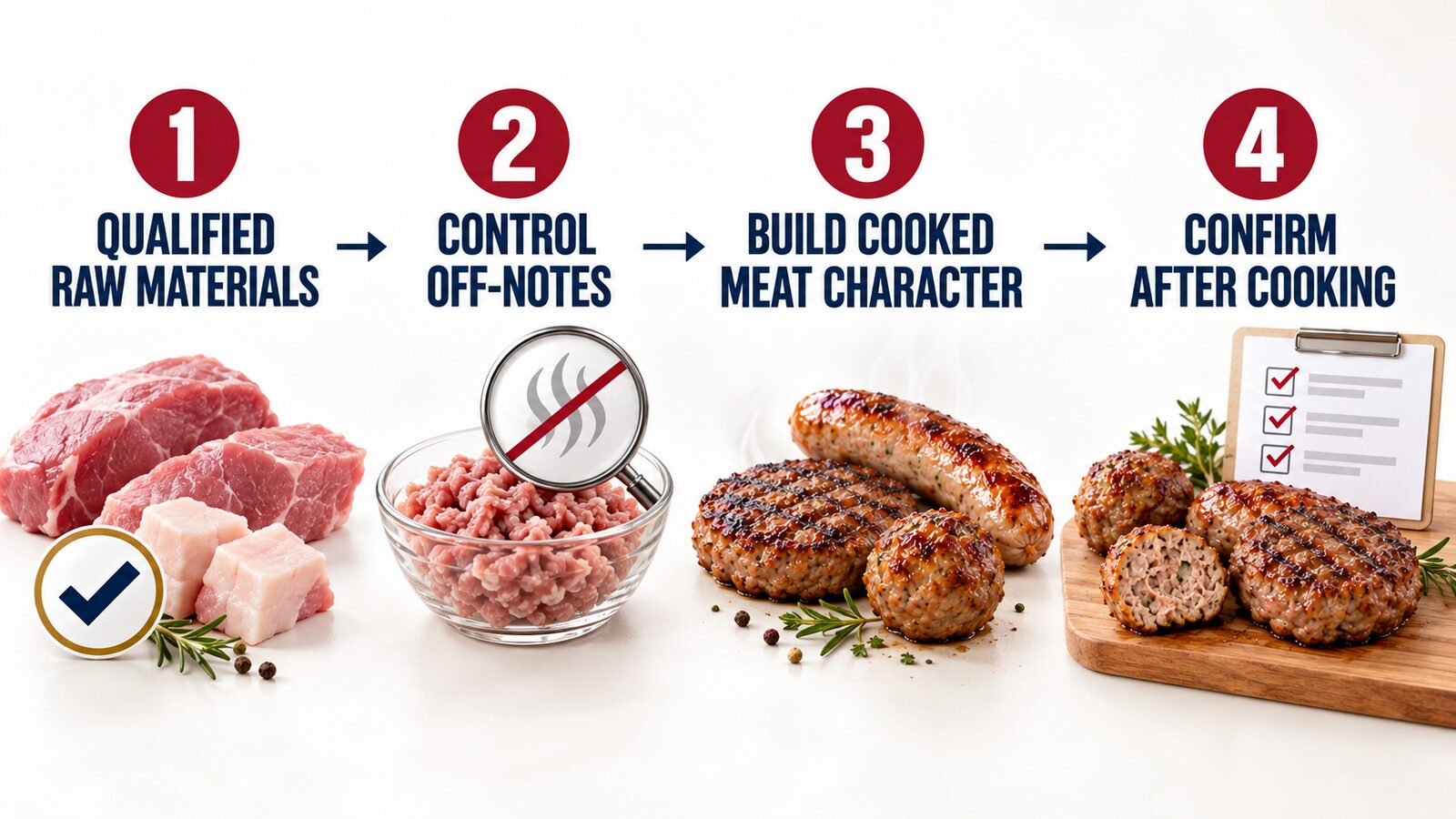
Flavor adjustment begins only after the meat, fat and other raw materials meet the product's quality and safety specifications. A meat flavor can help reduce normal gamey, frozen-storage or processing-related notes in qualified materials, but it must never be used to conceal spoilage, rancidity or unsafe raw materials.
Check the raw material before seasoning. Record its odor, color, storage history, thawing condition and fat quality, and compare it with an approved control when possible. If an abnormal odor indicates deterioration rather than normal variation, reject or investigate the material instead of attempting to cover it with a stronger flavor.
This separation protects both product quality and the validity of the trial. A flavor test cannot provide useful results when the underlying raw material is outside specification.
2. Identify the Real Flavor Problem
The phrase weak meat flavor can describe several different defects. The cooked aroma may be too light, the meat identity may be unclear, the savory body may be thin, or an unwanted raw, gamey, frozen or oxidized note may be distracting the consumer.
Evaluate the unseasoned base and the current finished formula side by side. This helps determine whether the main issue comes from the raw material, the seasoning system, the added flavor or the process itself.
Describe the defect with specific sensory terms. A statement such as weak cooked meat aroma with a noticeable frozen-storage note gives the development team a clearer direction than simply saying that the product needs more flavor.
3. Define the Target Meat Character
Before selecting a flavor, define what the finished product should smell and taste like. A mild boiled-meat profile, a rounded cooked-meat character and a pronounced roasted profile require different flavor directions and may respond differently to the same processing conditions.
The target should also match the product name and market expectation. A beef product may need a darker roasted character, while a chicken product may require a cleaner and lighter profile. A general meat flavor can build body and continuity, but it should support rather than blur the intended identity.
Use a commercial reference, an approved benchmark or a written sensory description. Without a shared target, one evaluator may prefer stronger aroma while another prefers a cleaner finish, and the team may change dosage without solving the actual product objective.
4. Evaluate the Unseasoned Product Base
Prepare a control sample without the added meat flavor while keeping salt, spices, binders and other ingredients unchanged. Cook it under the intended production conditions and evaluate it at the same temperature and time point as the flavored samples.
The control reveals the natural aroma of the meat system and shows which notes already come from spices, smoke, fat or heat. It also helps distinguish a flavor problem from a texture or seasoning problem.
For example, a dry product with high cooking loss may appear weak and short in flavor even when the aroma dosage is reasonable. Increasing flavor may raise the initial impact, but it will not correct the process or moisture imbalance that causes the eating quality to remain thin.
5. Understand the Roles of Fat, Protein and Moisture
Fat, protein and water determine how aroma compounds are retained and released during cooking and consumption. A change in the lean-to-fat ratio can therefore change flavor perception even when the flavor dosage remains unchanged.
Fat may hold some aroma compounds and release them gradually during chewing. Very lean formulations can deliver a different aroma pattern and mouthfeel, while high-fat systems may delay or soften some top notes. Protein can bind certain volatile compounds, and changes in extraction, chopping or mixing can alter that interaction.
Moisture and cooking loss also matter. If more water or fat is lost during heating, the cooked sample may become denser, saltier or drier, and the balance between aroma, taste and texture may shift. Record formulation and yield data so that an apparent flavor change is not mistaken for a dosage problem.
6. Build the Flavor in Layers
A complete meat profile usually comes from the interaction of the raw material, cooking reactions, salt, spices, savory ingredients and added flavor. Treat these elements as one system instead of expecting one ingredient to provide every part of the profile.
Start with the natural character of the product base. Use the meat flavor to strengthen cooked-meat identity and fill gaps, then adjust specific chicken, beef, roasted, smoked or spice notes as required. When several strong notes are added at the same time, the profile can become heavy and difficult to diagnose.
Change one major variable at a time. If the flavor, smoke and spice level are all changed in one trial, the team cannot identify which change improved the sample or caused a new imbalance.
7. Choose the Right Addition Method
Powder meat flavors can often be added by dry blending with salt, spices and other powder ingredients before they are mixed into the meat system. This method is practical when the powder blend disperses evenly and the mixing sequence provides enough time for uniform distribution.
Pre-dissolution or pre-dispersion may be useful when a direct dry addition creates localized concentration, dusting or uneven distribution. The correct procedure depends on the flavor, the available water, the mixing system and the product process, so the supplier's instructions should be followed.
For HiDoo Meat Flavor Powder, one application test method is to disperse 1 g of product in 55 mL of water, heat the mixture to 90°C, and then add and mix it evenly according to the product process. This is a product-specific method, not a universal instruction for every meat flavor powder.
8. Compare Several Dosage Levels
Do not evaluate only one flavored sample against an unflavored control. Prepare at least three dosage levels so the team can see how aroma impact, meat identity, off-note control and aftertaste change across a practical range.
HiDoo Meat Flavor Powder is commonly evaluated within a starting range of 0.05–0.30%, depending on the product and the desired intensity. A useful trial may compare a low, medium and high level within that range. These levels apply to this product and should not be treated as a general standard for all suppliers or all applications.
Weigh every addition accurately and keep batch size constant. For small laboratory trials, an error of a fraction of a gram can change the intended comparison. Label samples with blind codes when possible and record the exact dosage before processing.
9. Evaluate After the Actual Cooking Process
Raw meat batter does not show how the final flavor will perform. Heating can create desirable cooked and roasted notes, release or remove volatile compounds, concentrate salt and spices, and change the balance between fat, water and protein.
Process every trial with the same chopping, mixing, holding, filling and cooking conditions. Use the product's validated food-safety process and record the relevant time, temperature, yield and cooling conditions. A sample cooked harder or held longer cannot be compared fairly with the others.
Evaluate the product at the point when customers will consume it. Depending on the application, this may include evaluation immediately after cooking, after cooling, after refrigerated or frozen storage, and after reheating. A sample that performs well when hot may seem flatter or more artificial after cooling.
10. Evaluate Aroma, Taste and Eating Quality Separately
A stronger aroma does not automatically mean a better product. Evaluate several attributes separately so that one intense first impression does not hide problems in taste or texture.
The sensory sheet should cover cooked-meat aroma, target species identity, roasted or boiled character, savory fullness, unwanted raw or frozen notes, salt and spice balance, bitterness, aftertaste, tenderness and juiciness. The texture observations do not prove that the flavor caused a physical change, but they show whether the complete eating experience is moving in the right direction.
Ask evaluators to score samples before discussing them as a group. Independent scoring reduces the chance that one confident opinion will influence everyone else's result.
11. Recognize Under-Dosage and Over-Dosage
Under-dosage may appear as a weak cooked-meat aroma, poor species identity, a short savory finish or insufficient control of normal raw-material notes. The sample may taste seasoned but still lack a convincing meat center.
Over-dosage can create a sharp or perfumelike top note, bitterness, an overly persistent aftertaste or a generic flavor that covers the natural meat and spice character. A high dosage may also make the product seem strong when hot but unbalanced after cooling.
Select the lowest dosage that reaches the target profile consistently. This usually produces a cleaner result and leaves room for the natural raw material, cooking process and seasoning system to contribute.
12. Confirm the Result at Pilot or Production Scale
A laboratory result must be confirmed under realistic mixing, filling and cooking conditions. Larger equipment changes shear, mixing time, temperature development, hold time and the distribution of powders and liquids.
Run a pilot or controlled production trial using the selected dosage and the final mixing sequence. Compare samples from the beginning, middle and end of the batch when possible. This can reveal distribution problems that a small hand-mixed trial cannot show.
Confirm product yield, sensory consistency and performance after the intended storage period. If the production result differs from the laboratory sample, investigate process and distribution variables before changing the dosage.
13. Final Evaluation Checklist
Use the following checklist before approving the meat flavor dosage and process:
✓ The meat and fat raw materials meet quality and safety specifications.
✓ The specific flavor defect and target meat character are clearly defined.
✓ An unflavored control and several accurately measured dosage levels were compared.
✓ The formulation, mixing sequence and processing conditions were kept constant.
✓ Every sample was evaluated after the actual cooking process.
✓ Aroma, taste, off-notes, aftertaste and eating quality were scored separately.
✓ The selected level does not create bitterness, a perfumelike note or excessive persistence.
✓ The result was confirmed after cooling, storage or reheating when relevant.
✓ Pilot or production-scale distribution and consistency were verified.
✓ The final dosage, process and sensory decision were recorded.
14. Conclusion
Improving meat flavor requires more than increasing the amount of flavor powder. The product team must begin with qualified raw materials, define the exact sensory problem, understand how the formulation and process affect aroma, and compare controlled dosage levels in the finished product.
The most reliable result is the lowest dosage that delivers a clean and recognizable meat character without bitterness, artificial impact or loss of the product's natural identity. That result should then be confirmed under the actual mixing, cooking, storage and reheating conditions used in commercial production.
HiDoo provides Meat Flavor Powder, Chicken Flavor Powder and Beef Flavor Powder, together with sample support and practical application guidance for sausages, meatballs, burger patties, marinated meat, meat fillings and other savory products.