A food flavor can perform very differently at different dosage levels. Too little may leave the finished product weak or incomplete. Too much may make the aroma sharp, artificial, unbalanced or tiring after repeated consumption.
The right dosage is therefore not simply the highest level that produces a noticeable aroma. It is the level that delivers the intended flavor profile, works with the product base, survives processing, remains stable during storage and is commercially practical for production.
Finding that level requires a controlled evaluation rather than a single trial.
◆ Before testing, define the target flavor profile, the product base, the processing conditions and the performance that should remain in the finished product.
1. Define the Target Before Adjusting the Dosage
Dosage cannot be evaluated without a clear target. "Stronger" is not a complete technical requirement because a stronger top note may not improve the body, authenticity or aftertaste of the flavor.
Before testing, define:
◆ Intended flavor direction: fresh, ripe, creamy, roasted, juicy or cooked
◆ Final application: beverage, cake, biscuit, confectionery, dairy, sauce or snack seasoning
◆ Desired intensity in the finished product
◆ Processing conditions
◆ Expected shelf life and storage conditions
◆ Cost and label constraints
A clear target makes comparison more objective and prevents dosage from compensating for the wrong flavor profile.
2. Understand Why There Is No Universal Dosage
The same flavor may require very different dosage levels in different products. Water, fat, sugar, protein, salt, acidity and starch all affect aroma release and perception.
For example:
◆ A flavor may smell strong in water but become weaker in a high-fat dairy base.
◆ Sugar may soften sharp notes while increasing the perception of others.
◆ Acidity may brighten a fruit profile but distort creamy or delicate notes.
◆ Protein and starch can bind aroma compounds.
◆ Salt, spices and savory ingredients may mask or redirect the flavor profile.
Dosage recommendations are application-specific starting points, not universal values.
3. Start With the Supplier's Recommended Range
A supplier's recommended dosage range is useful for beginning the trial, especially when it is based on the same or a similar application. However, it should not be treated as the final answer.
The recommendation may have been developed in a reference formula with different sugar, fat, protein, acidity or processing conditions. Your own product must still be tested under realistic conditions.
When requesting samples, provide:
◆ Product type and flavor target
◆ Liquid or powder application
◆ Key formulation characteristics
◆ Process temperature and time
◆ Expected storage period
◆ Current dosage level and observed problem
This allows the supplier to recommend a more relevant starting range and reduces unnecessary trial cycles.
4. Compare Low, Medium and High Dosage Levels
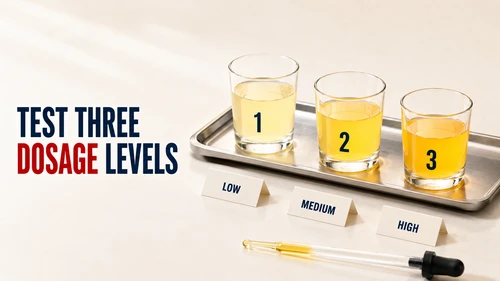
Instead of testing one dosage at a time, prepare at least three controlled levels around the recommended starting point.
Low level: enough to show the direction without dominating the base.
Medium level: the expected working dosage.
High level: strong enough to reveal whether additional dosage improves the product or creates imbalance.
The exact interval depends on the flavor strength and application. For some products, small changes can be obvious; for others, a wider interval may be needed.
Use blind sample codes such as 1, 2 and 3 rather than labeling samples "low," "medium" and "high." This reduces expectation bias during evaluation.
5. Measure Accurately and Record Every Trial
Small measurement errors can produce large differences when working with concentrated food flavors. Use a suitable precision scale, pipette or measuring device, and apply the same method to every sample.
Record:
◆ Sample code
◆ Flavor name and batch
◆ Exact dosage
◆ Base formula quantity
◆ Mixing order and mixing time
◆ Processing conditions
◆ Evaluation time
◆ Sensory comments and panel preference
Do not rely on drops unless the drop size has been verified. Drop volume can vary with the pipette, viscosity, temperature and handling method.
For production, express the dosage in a reproducible unit such as grams per kilogram or percentage.
6. Keep All Other Variables Constant
A dosage comparison is valid only when dosage is the main variable. Use the same formula, ingredient batch, mixing order, mixing time, process, fill quantity and evaluation temperature.
Avoid changing sweetness, acidity, color, stabilizer or other ingredients during the same comparison. If several factors change together, the result cannot be attributed to dosage.
If the base formula requires adjustment, first complete the dosage screen, stabilize the formula, and then repeat the confirmation test.
7. Evaluate After the Actual Production Process
Bottle aroma or an unprocessed sample is not enough. Heat, baking, extrusion, homogenization, drying, freezing, pressure and aeration can all change flavor intensity and balance.
Use the real process or the closest practical pilot simulation.
Evaluate whether:
◆ The top note remains clear
◆ The flavor body remains full
◆ The base masks or distorts the profile
◆ Heating creates cooked, bitter or artificial notes
◆ Cooling changes aroma release
◆ The aftertaste remains pleasant
◆ The dosage still matches the target after processing
A level that seems ideal before processing may become weak afterward. A moderate level may also become excessive after concentration, baking or drying.
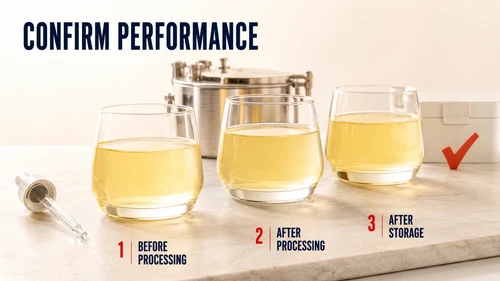
8. Evaluate at More Than One Time Point
Flavor perception can change after mixing, processing, cooling and storage.
Useful checkpoints include:
◆ Immediately after preparation
◆ After processing and cooling
◆ After 24–48 hours
◆ During intermediate storage
◆ Near the intended shelf-life endpoint
These checks are especially important for beverages, dairy products, baked goods, fillings, sauces and products exposed to heat or light. Some flavors become smoother after equilibration, while others lose freshness, separate or develop an unwanted aftertaste.
9. Recognize Under-Dosage and Over-Dosage
Possible signs of under-dosage:
– The intended flavor is difficult to identify
– The top note is brief and the flavor body is weak
– The product base dominates the profile
– The aroma disappears during processing or storage
– The finished product feels incomplete or lacks continuity
Possible signs of over-dosage:
– The aroma becomes sharp, perfumery or solvent-like
– One note dominates the complete profile
– Bitterness, harshness or an artificial aftertaste appears
– Sweetness or acidity becomes less balanced
– The first taste is attractive but becomes tiring
– Cost increases without a meaningful sensory benefit
The best dosage is not the strongest level. It is the level that remains complete, balanced and stable.
10. Confirm the Dosage at Pilot or Production Scale
Scale changes the result. Larger mixing systems, different shear, holding time, heating, filling and process losses may alter flavor performance.
Before full commercial production:
✓ Confirm the selected dosage in a pilot batch
✓ Compare it with the laboratory reference
✓ Verify the addition point and mixing procedure
✓ Check distribution uniformity
✓ Evaluate the packed product after stabilization
✓ Document the final dosage and process conditions
If performance changes after scale-up, do not immediately increase the dosage. First check weighing accuracy, the addition point, mixing, process loss and storage conditions.
Final Dosage Evaluation Checklist
✓ The target flavor profile is clearly defined
✓ Testing uses the actual or closest practical product base
✓ Low, medium and high dosage levels are compared
✓ Measurements are accurate and reproducible
✓ Non-dosage variables are kept constant
✓ The actual production process is evaluated
✓ Cooling and storage checkpoints are included
✓ Under-dosage and over-dosage signs are reviewed
✓ Pilot or production-scale performance is confirmed
✓ The final dosage and process are documented
Conclusion
Determining the right food flavor dosage is a structured process of testing, processing and confirming. A supplier's recommended range is a useful starting point, but the final level must be selected in the real product base under realistic processing and storage conditions.
The goal is not maximum intensity. It is the lowest practical dosage that delivers the required flavor profile, balance, process performance and shelf-life stability.
HiDoo provides liquid and powder food flavors, sample support and application guidance for beverage, bakery, confectionery, dairy, savory and seasoning products.
www.hidoofood.com
gary@hidoofood.com