A food flavor that performs well in one product may appear weaker, sharper, heavier or less balanced in another. Even when the flavor, dosage and supplier are exactly the same, the final sensory result can change significantly.
The reason is simple: a food flavor is never experienced in isolation. Water, fat, protein, sugar, acid, salt, starch, hydrocolloids and the production process all influence how aromatic compounds dissolve, remain in the product and reach the consumer's senses.
Understanding these interactions helps manufacturers avoid a common mistake: judging a flavor only in water or in a simplified laboratory base, then expecting identical performance in the commercial product.

1. The Product Base Is Part of the Flavor System
Flavor selection is often treated as a question of choosing the right aroma profile and dosage. In practice, the product base is equally important because it determines the environment in which the flavor must perform.
A pineapple flavor added to a clear beverage, a dairy drink, a gummy candy and a bakery filling may produce four noticeably different results. The flavor may smell bright and fresh in one application but appear creamy, muted or heavy in another.
This does not necessarily mean the flavor is inconsistent. It usually means the flavor compounds are interacting differently with each product matrix.
2. Water Content and Solubility Affect Distribution
The first question is whether the flavor can distribute evenly in the product. Water-soluble or water-dispersible flavors are generally easier to incorporate into beverages and other high-moisture systems. Oil-soluble components may require a suitable carrier, emulsification system or mixing method.
If the flavor does not disperse uniformly, one part of the batch may taste stronger than another. Surface oiling, aroma loss during mixing or an unstable appearance can also occur.
For this reason, a flavor should be evaluated not only for aroma quality but also for compatibility with the actual product base.
3. Fat Can Retain Aroma and Change Its Release
Many aroma compounds have an affinity for fat. In a higher-fat product, some volatile compounds may remain in the fat phase instead of being released immediately into the air during tasting.
This can make the initial aroma seem softer or slower, while also helping certain notes remain longer in the mouth. In a low-fat or water-based product, the same flavor may appear brighter and more immediate but may disappear more quickly.
The practical result is that a dosage selected in water may not transfer directly to ice cream, cream fillings, chocolate coatings or other fat-containing applications.
4. Protein Can Bind or Suppress Certain Flavor Notes
Milk proteins, soy proteins, pea proteins and other protein ingredients can interact with some aroma compounds. Depending on the formulation, this may reduce the intensity of particular top notes or change the balance of the flavor profile.
Plant-protein products can also introduce beany, earthy, bitter or astringent background notes. A flavor that seems clean in water may need greater body, better masking or a different aroma balance when used in a plant-based drink.
The best solution is not always to increase the dosage. Sometimes a more suitable flavor profile or supporting flavor system produces a cleaner result with less risk of over-flavoring.

5. Sugar, Acid and Salt Change Flavor Perception
Sugar does more than add sweetness. It can round harsh edges, increase the perception of ripe fruit or creamy notes, and change the balance between aroma and taste. However, a very high sugar level may also make some profiles feel heavy or less fresh.
Acid is especially important in fruit beverages, gummies and confectionery. Citric, malic and other food acids can increase freshness and make fruit notes appear more vivid, but excessive acidity may make the same flavor seem sharp, thin or unbalanced.
Salt and savory ingredients can strengthen certain meaty or roasted impressions while suppressing others. A savory flavor should therefore be tested in the complete seasoning or food base, not only in plain water.
6. Viscosity Influences How Quickly Aroma Is Released
Starch, pectin, gums and other hydrocolloids change the movement of the product in the mouth and can slow the release of volatile aroma compounds. A thicker product may need more time before its full flavor is perceived.
This is why a flavor may seem strong in a thin laboratory solution but weaker in a sauce, filling, yogurt, syrup or gel. Texture and aroma should be evaluated together because consumers experience them at the same time.
7. Processing and Storage Can Increase the Difference
Heating, baking, pasteurization, homogenization, drying, freezing and prolonged mixing can all change flavor performance. Volatile top notes may be lost, while other components may interact with the product or become more noticeable after processing.
Storage is equally important. A newly prepared sample may smell attractive, but the balance can change after 24 hours, several days or a realistic shelf-life period. Packaging, temperature, light and oxygen exposure may also affect the result.
The flavor should therefore be evaluated after the real production process and again at suitable storage checkpoints.
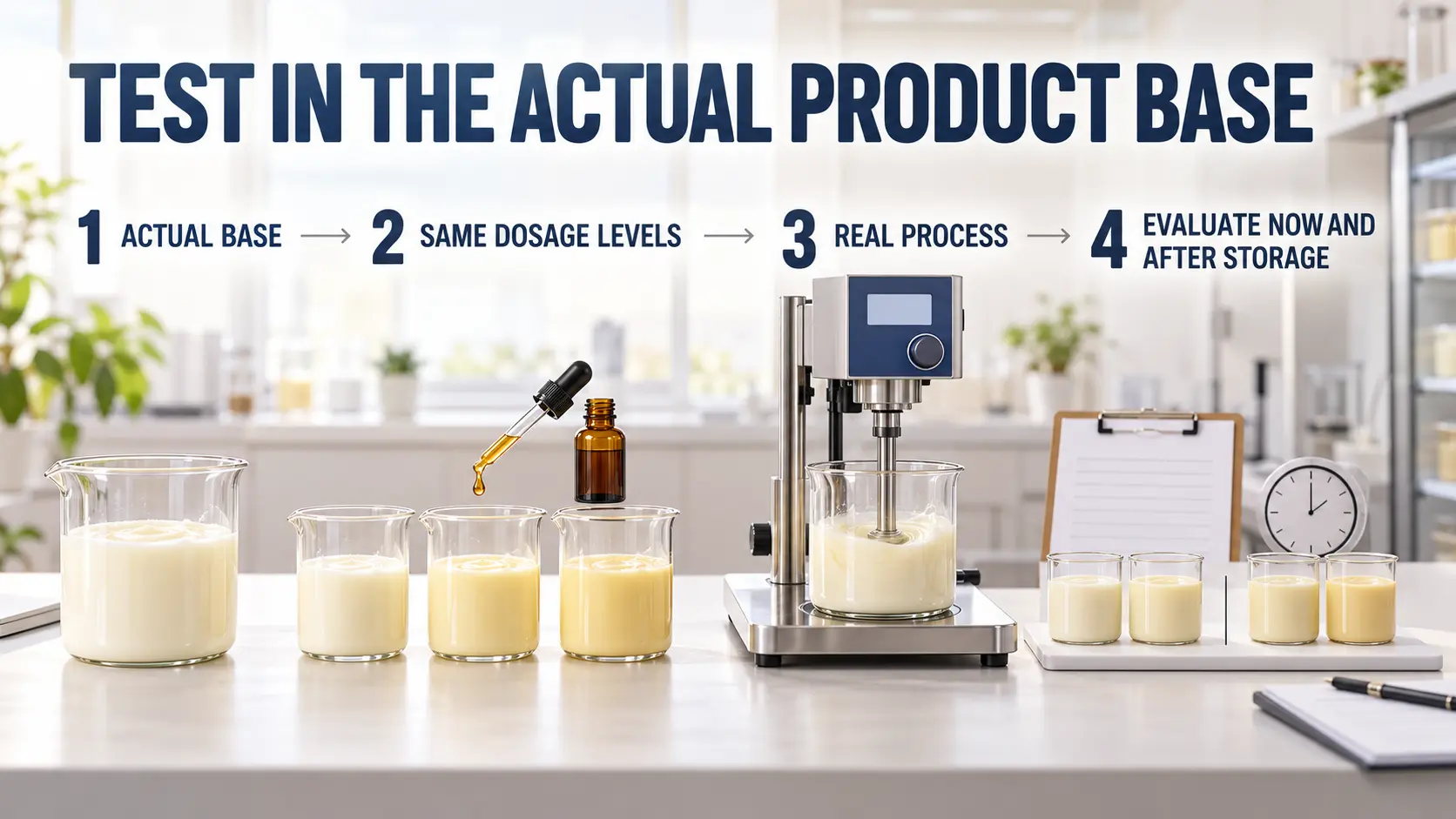
8. Use Controlled Trials in the Actual Product Base
A reliable evaluation compares samples under controlled conditions. Prepare one reference sample without added flavor, then prepare low, medium and high dosage levels using the same base formula.
✓ Use the actual commercial product base whenever possible.
✓ Keep sugar, acid, salt, fat, protein and stabilizer levels constant.
✓ Measure flavor accurately by weight or calibrated volume.
✓ Apply the real heating, mixing, cooling or drying process.
✓ Evaluate immediately and again after defined storage periods.
✓ Record aroma intensity, taste balance, aftertaste, stability and overall preference.
This approach shows whether the problem comes from dosage, compatibility, processing or the flavor profile itself. It also prevents changes to several variables at the same time, which can make the result difficult to interpret.
9. Adjust the System, Not Only the Dosage
When the flavor is not performing as expected, increasing the dosage should not be the automatic response. A stronger dosage can create chemical, bitter, perfumery or lingering notes without solving the underlying compatibility problem.
Depending on the application, the better adjustment may involve:
- choosing a liquid, powder, water-dispersible or oil-compatible format;
- selecting a profile with greater heat resistance or more suitable top and base notes;
- changing the addition point to reduce aroma loss;
- improving dispersion or mixing;
- balancing sweetness, acidity, saltiness or masking support;
- confirming the result through pilot-scale production before full-scale use.
10. Final Evaluation Checklist
✓ Was the flavor tested in the real product base?
✓ Was the flavor format compatible with the system?
✓ Were all non-flavor variables kept constant?
✓ Was the sample processed under realistic conditions?
✓ Was it evaluated at more than one time point?
✓ Were low, medium and high dosage levels compared?
✓ Was the final choice confirmed at pilot or production scale?
Conclusion
The same food flavor can perform differently because every product base changes the way aroma is distributed, retained, released and perceived. Fat, protein, sugar, acid, salt, viscosity, processing and storage all contribute to the final result.
The most dependable approach is to test the flavor in the actual product, control the variables and evaluate the sample after realistic processing and storage. This produces a more accurate dosage decision and reduces the risk of expensive adjustments during commercial production.
HiDoo provides liquid and powder food flavors, sample support and application guidance for beverage, bakery, confectionery, dairy, savory and seasoning products.