A liquid flavor can be sold by net mass while a trial operator measures it by volume. Unless the units are reconciled, the trial may receive a different amount from the one intended.
For ingredient importers, wholesalers and distributors, a clear handover should connect the product, the dose and the measurement method.
1. Keep mass and volume separate
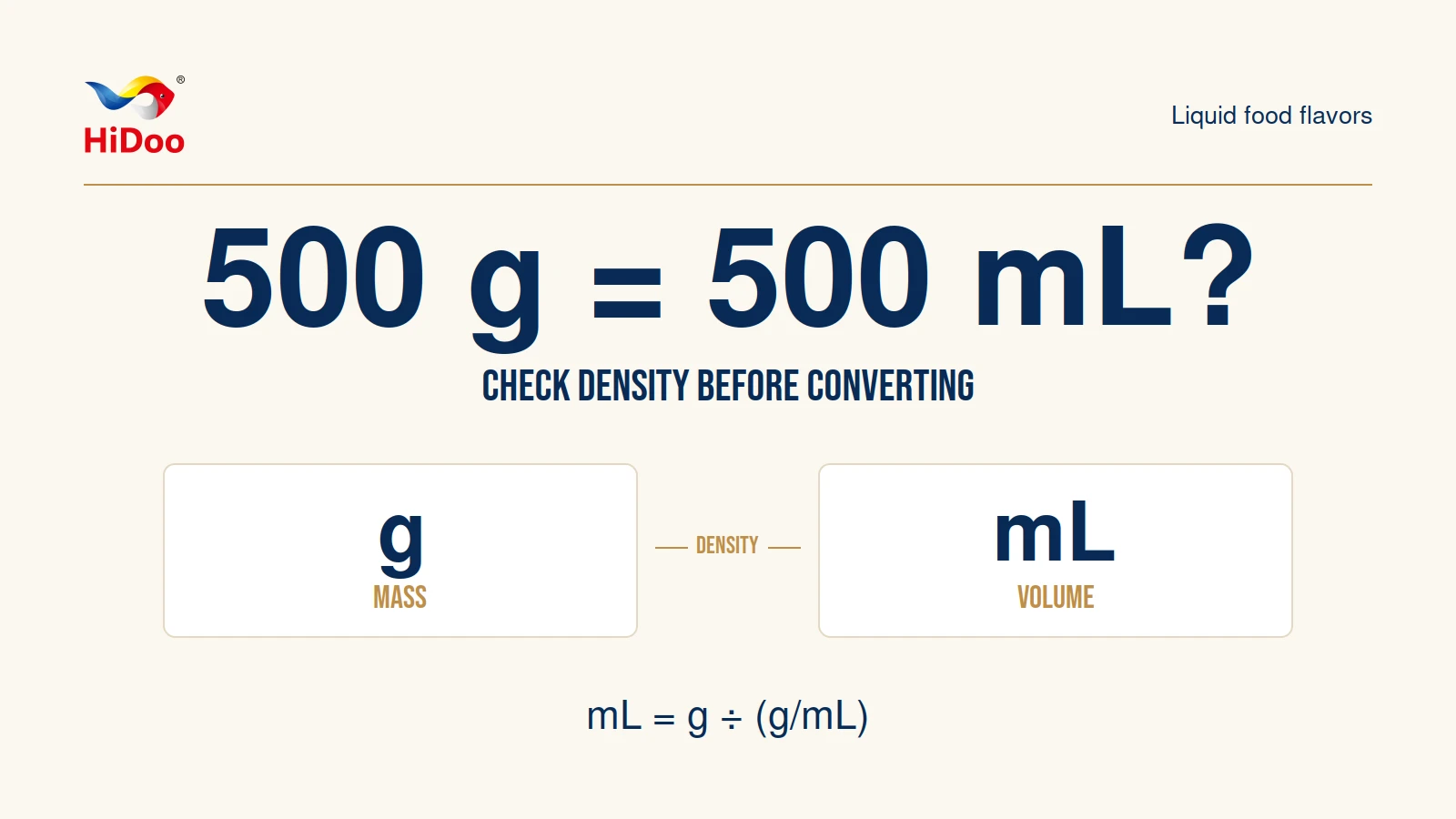
Grams and kilograms express mass. Milliliters and liters express volume. The number printed beside one unit cannot simply be transferred to the other.
HiDoo's sweet flavor catalogue lists liquid packs in both types of unit: 28 mL, 500 g and 1 kg. This describes packaging formats across the range; it does not establish a universal mass-to-volume conversion or confirm every pack for every individual product.
Density connects the two quantities. Using density expressed in g/mL:
Volume (mL) = mass (g) ÷ density (g/mL).
Mass (g) = volume (mL) × density (g/mL).
2. Work through one clearly labeled example
Assume a liquid flavor has a density of 1.10 g/mL at 20°C. This density is hypothetical; it is not a HiDoo specification or a recommended dosing condition.
A net mass of 500 g corresponds to approximately 454.5 mL at the stated density:
500 ÷ 1.10 ≈ 454.5.
Similarly, a 100 g addition corresponds to approximately 90.9 mL. An addition of 100 mL instead would deliver 110 g.
|
Quantity |
Calculation |
Result |
|---|---|---|
|
500 g converted to volume |
500 ÷ 1.10 |
approximately 454.5 mL |
|
100 g converted to volume |
100 ÷ 1.10 |
approximately 90.9 mL |
|
100 mL converted to mass |
100 × 1.10 |
110 g |
The arithmetic does not establish bottle capacity, fill level, aroma strength or product quality.
3. Define what the dose is based on
Suppose a trial specifies 100 g of flavor per 100 kg of unflavored product base. That is 0.1% of the unflavored base by mass.
It is not exactly the same instruction as 0.1% of the final mixture's mass. Rather than leave the basis implicit, write down the flavor quantity, the base quantity and their units.
At the hypothetical density above, substituting 100 mL for the specified 100 g adds 10% more flavor by mass. This does not imply a 10% increase in perceived flavor; it identifies a change in the trial input.
4. Confirm the conversion before using it
Ask for density information for the exact product, with its units and reference temperature. Do not transfer a conversion from another flavor, product code or formulation.
Check that the density units and reference conditions are clear before converting. If usable density information is unavailable, keep a mass-based trial instruction mass-based.
For a trial specified in grams, use a balance suitable for the required addition. If a production line uses volumetric dosing, verify the mass actually delivered under the operating conditions and record the measurement basis.
5. Give the next person a usable instruction
A short handover can read:
Product code: [confirmed code].
Add [confirmed mass in g] to [confirmed mass in kg] of [defined unflavored base].
Measurement method: [weighing or verified dosing system].
If conversion is necessary: [confirmed density, unit and reference temperature].
Trial record: [actual amount added and measurement method].
These fields are a communication aid, not a universal dosage recommendation.
HiDoo provides existing product selection, samples, dosage and application guidance. Share your application, target aroma and measurement method so that sample instructions can be discussed clearly.
References: NIST Guide to the SI, Chapter 8, section 8.6.7; NIST SI Units – Volume.